.png)
WE STAFFED A 4,000+ PERSON CONFERENCE FOR THE FIRST TIME — AND GOT IT RIGHT

When we received a request to staff a three-day corporate conference at Bellagio Las Vegas with more than 4,000 attendees, I didn’t look at it and think, Okay, we’ve done this before!
We hadn’t.
XS had staffed trade shows, corporate events and multi-day activations with teams of 10, 20 or 30 people, but this was the first time we were responsible for a conference operation of this size.
And we needed to show professionalism and knowledge to a potential client who initially sent us basically this:
“3-day conference, 4,000–6,000 attendees at Bellagio. Registration, badge scanners, directional staff, and wayfinders.”
No indication of how many staff they needed. No detailed schedule. No floor plan. Not much else. But we wanted to win this client.
My first reaction was: Okay. How do we show the client that we understand how to staff an event of this scale when we haven’t actually done one before?
I didn’t have a previous 4,000-person conference playbook to copy. What I did have was something I’ve been doing for most of my professional life: logistics.

FIRST, WE HAD TO FIGURE OUT WHAT WE DIDN’T KNOW
The obvious question was: How many conference staff do we need? Twenty? Thirty? Forty?
At first, 4,000–6,000 attendees sounds like the number you should use to calculate how many conference staff you need.. But very quickly, I realized that number didn’t actually tell me much.
If 1,500 people arrive within one hour, registration needs one level of coverage. If those same 1,500 people arrive over four hours, it needs something completely different.
If all conference rooms are located around one ballroom, you may need relatively few wayfinders. If registration, breakout rooms, lounges, the Expo Hall, and the main sessions are spread across Bellagio’s conference space, suddenly the floor plan matters just as much as the attendance.
So before calculating staff count, we started calculating what information we needed from the client.
What time does registration open each day?
When are the first and last sessions?
How many registration stations will there be?
When are the expected arrival peaks?
Where will badge scanning be required?
How many breakout rooms are running simultaneously?
When does the Expo Hall open?
How many attendees are expected at the Gala?
Where exactly are all of these functions located inside Bellagio?
The more questions we asked, the clearer the staffing model became. We requested the full agenda. We requested the floor plan. Then we started mapping staffing against what was actually happening throughout each day rather than trying to calculate it from one big attendance number.
And that was the first moment when I knew we were approaching it correctly.
The client confirmed that this was exactly how they planned their conference staffing as well: based on the agenda and floor plan, rather than on the total number of attendees.
That was important.
We hadn’t won the event by pretending we already knew every answer. We started winning the client’s confidence by asking the right questions.
I TREATED THE CONFERENCE AS A LOGISTICS PROJECT
Before starting XS Event Staffing, I spent years working in corporate environments across hospitality, logistics, beauty, and oil & gas. I’ve delivered machinery internationally, booked speakers and attendees for conferences, coordinated products and services across different countries, and spent thousands of hours working with corporate clients.
Different industries, same basic problem: there are a lot of moving pieces, and they all need to arrive at the right place at the right time.
A large conference isn’t that different. The “cargo” happens to be people. Twenty to thirty staff members need to arrive at the correct entrance of a massive Bellagio Las Vegas property, on time, in the correct uniform, knowing where to report, who their Captain is, what their responsibilities are, and what happens next.
Then thousands of attendees arrive.
If you wait until 6:00 AM on event day to figure all of that out, you are already late.

WE REMOVED UNCERTAINTY BEFORE THE FIRST EVENT DAY
One thing became obvious during planning: I couldn’t just send 20 conference staff an address and a call time and expect everyone to be at the meeting point on time.
Large Las Vegas properties such as Bellagio can be confusing even for people who live in the city. Finding the convention center is one thing. Finding the correct staff parking area is another. Arriving at the exact meeting point inside that convention center at 5:45 in the morning is something else entirely.
So we prepared the team before they arrived.
The day before the conference, our Event Captains attended an on-site walkthrough with the client. But I didn’t want the information from that walkthrough to stay only with the few people who could physically be there.
So I turned the walkthrough into a live-streaming briefing for the rest of the team.
I bought a movement-stabilizing selfie stick and a small wireless microphone that connected to my phone. While I walked through the conference space with our Captains, the client representative conducting the walkthrough wore the microphone. Staff joining remotely could see where we were going and, more importantly, hear the client’s instructions in real time.
They could see the registration areas, understand the conference layout, hear where different positions would be located, and follow the same walkthrough our Captains were receiving onsite.
And because not everyone could join the live briefing, we recorded the entire walkthrough. Every staff member booked for the conference who couldn’t attend live was asked to watch the recording before arriving for their first shift.
I did something similar with arrival logistics for the staff. I created three separate video guides showing staff where to pick up their parking passes, where to park, which way to walk, and even how to cross through the Bellagio loading area to take a shortcut to our meeting point.
By the time someone arrived for work, I didn’t want Bellagio, the meeting point, or the basic conference setup to be completely new information.
The goal was simple: I didn’t want our first real briefing to happen while the client was already watching us work.
By the time attendees started arriving, the staff needed to look like they belonged there.
WE DIDN’T BOOK EVERYONE WHO APPLIED
This was probably one of the harder decisions.
Large conference staffing isn’t necessarily the highest-paid work in the event industry. Trade show brand ambassadors, product specialists, and other specialized event roles can command higher rates. For this conference, we had to keep the client’s budget realistic while still paying enough to attract reliable event staff for three consecutive 12-hour days.
Although we offered a market-standard rate for event staff, we weren’t going to have every top-tier trade show professional in Las Vegas fighting for the assignment. But a three-day event with long shifts was still attractive because it offered consistent hours and meaningful earnings over three days.
We received plenty of applicants. That didn’t mean we booked all of them.
For this particular conference, I cared much more about how someone communicated, whether they could follow instructions, whether I trusted them to speak to a corporate attendee, and whether they could remain professional during a very long day.
Sometimes that meant continuing to recruit even when technically there were enough applicants in the system.
Having 20 names on a schedule is not the same as having the right 20 people.

THE STAFF NEEDED TO UNDERSTAND MORE THAN ONE JOB
We weren’t hiring 20 conference staff to stand in 20 predetermined spots for three days.
And yes, even with careful selection, not every staffing decision works perfectly — especially during long hours over multiple days. People get tired. They finish late, go home, and wake up early the next morning for three consecutive days. That can affect people’s ability to perform at their best, and we were prepared for it.
Someone decides after the first day that the job isn’t their cup of tea. Someone quits last-minute or oversleeps. Someone’s baby gets sick overnight. Someone gets tired and starts showing attitude toward colleagues or, worse, the client. All of that needs to be taken into account when planning arrival coverage and managing the team throughout the conference.
That’s why we book extras who arrive onsite with the rest of the team, as well as standby staff who wait at home for the final call and can jump in the car and get to the venue quickly if needed.
And honestly, this is one of the best booking policies we’ve made for large events. With early call times and 20 people booked on one team, the extras and standbys almost always get used.
During this conference, for example, one employee was released from the assignment after performance and conduct issues. That’s part of managing people. The goal isn’t to pretend that nothing will ever go wrong. The goal is to identify the problem, deal with it without allowing it to disrupt the event, redistribute the coverage, and keep going.
Thousands of attendees don’t need to know that you just solved a staffing problem behind the scenes.
Neither should the client have to solve it for you.
CAPTAINS MADE 20 PEOPLE OPERATE LIKE ONE TEAM
There is a point where an event becomes too large for an owner, planner, or client to manage every staff member individually.
For us, Captains were the layer between planning and execution.
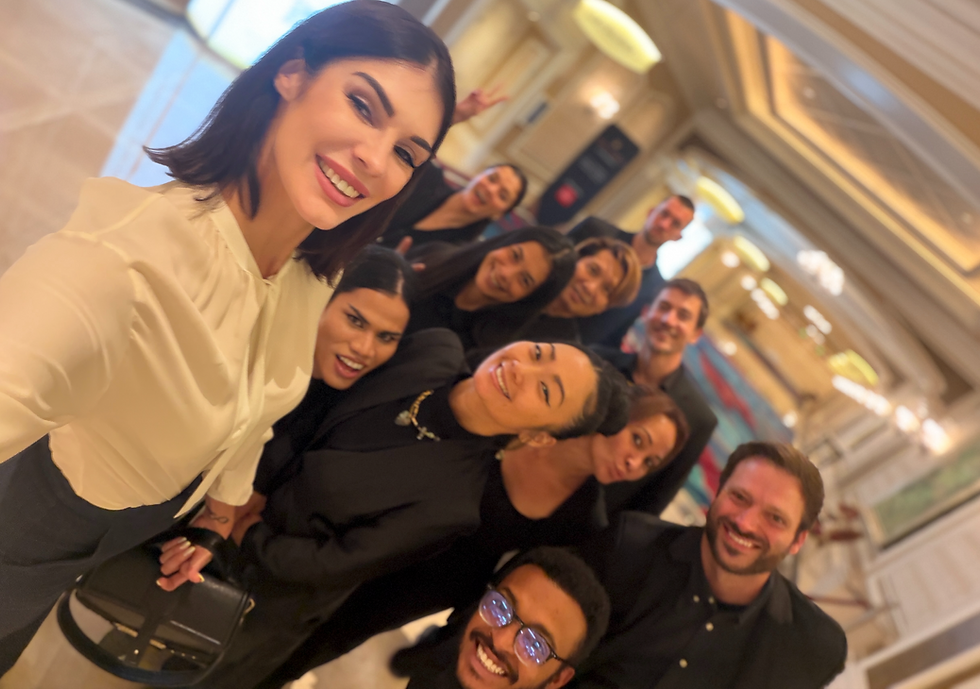
They knew where staff were supposed to be. They moved staff when conference traffic changed. They coordinated breaks during 12-hour days. They dealt with staff issues. They communicated with the client and with me at all times.
And we adjusted.
A plan created before an event is based on assumptions. Once thousands of real people start walking through the building, you get actual information. You see which entrance is busy, where attendees keep getting confused, which position doesn’t need as much coverage as expected, and where another person would actually help.
That information needs to move quickly through the team.
This is where logistics stops being a spreadsheet and becomes onsite management.
THE CLIENT DIDN’T NEED TO SEE HOW MUCH WAS HAPPENING BEHIND THE SCENES
I think this was ultimately the biggest success. The client didn’t hire us because they wanted to manage a staffing agency.
They already had a 4,000+ person conference to run. They shouldn’t have to chase our staff, explain where everyone needs to go, figure out break coverage, solve an employee issue, or wonder whether staff are going to show up the following morning.
That was our job.
And by the end of the conference, the feedback we received from a client who had been running this conference for years was essentially that this was one of the smoothest staffing experiences they ever had.
For me, that mattered even more because this was our first conference of this scale.
YOU DON’T NEED TO HAVE DONE THE EXACT SAME EVENT BEFORE
There is something I learned from this conference that applies far beyond event staffing.
Experience matters. But experience doesn’t always have to mean I’ve done this exact thing 25 times before.
Sometimes the transferable skill is understanding how to organize complexity. I didn’t walk into this project with a formula for staffing a 4,000-person conference. I asked a ridiculous number of questions. I studied the agenda. I studied the floor plan. I thought about how attendees would move. I thought about what could go wrong before it went wrong. I chose staff carefully. We briefed them. We created a management structure. And then we adjusted when reality inevitably differed from the plan.
That’s the kind of logistics I love!
It’s the same reason my background in completely different industries turned out to be useful when I moved into events.
Products, machinery, knowledge, staff — something needs to get from point A to point B, correctly and on time. At this conference, it just happens to involve a lot more name badges.
Events are human logistics. And sometimes the best indication that the logistics worked is that the client never had to think about them at all.


Comments